
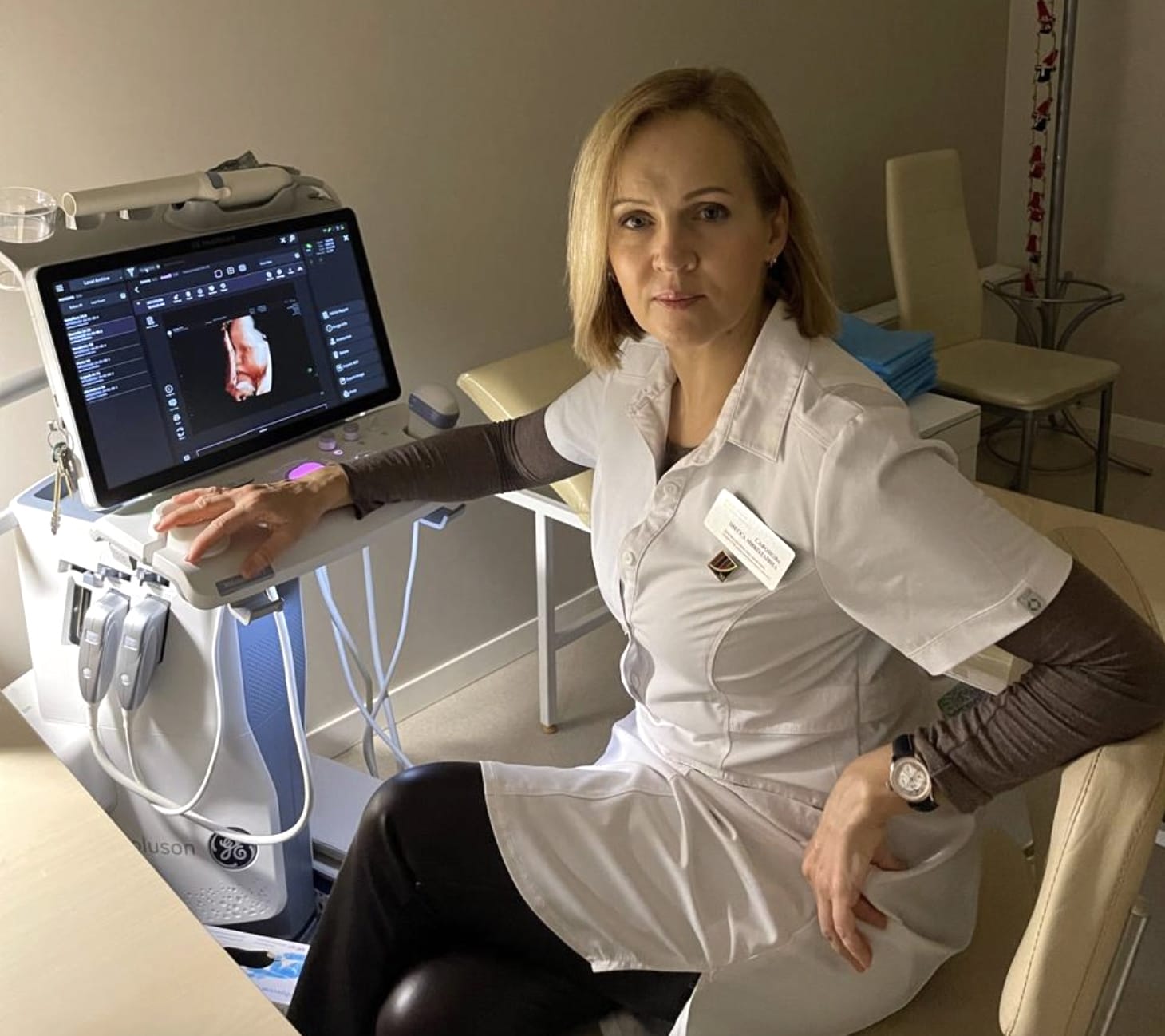
CANCÚN, Mexico—The white-sand beaches of Cancún, Mexico, where Dr. Inessa Safonova traveled to attend the 2025 International Society of Ultrasound in Obstetrics and Gynecology (ISUOG) World Congress, are a world away from the front lines of Russia’s long-running war with Ukraine.

It’s an area Dr. Safonova knows all too well. Her clinic is based in Kharkiv, Ukraine, a city less than 20 miles from the Russian border. The clinic, located in the hospital’s basement, has survived three direct attacks since the war began.
But this hasn’t stopped her from providing lifesaving medical care to the women who need it.
“We have arranged an ultrasound room, and I provide routine screening and expertise for complicated cases,” she told EC Companion.
As one of this year’s six travel grantees—and an ISUOG Ambassador for Eastern Europe—the doctor and radiology professor attended the conference to present her paper, “Uterine fibroid with massive cystic hydropic degeneration: pre-surgical ultrasound diagnosis and surgical correlations,” before some 2,500 delegates.
Endometrial cancer (EC) is the most common gynecological cancer in Ukraine, Dr. Safonova said. Fortunately, most women with the disease have a low-risk type, which is curable.
“As for high-risk EC, it’s really a sad story,” she said. “Many women have left Ukraine, and they’re spread all over Europe. From time to time, we see them. They come to Kharkiv to receive medical assistance, but it’s impossible for them to live in Ukraine, especially with children.”
That Dr. Safonova was able to fly to Mexico at all is an achievement in itself. Ukrainian airspace has been closed to commercial traffic since 2022, and all its major cities—including Kyiv, Kharkiv and Odesa—are under threat of Russian air strikes.

“Although Ukraine is large, the war has really affected large parts of our country,” she said. “Some areas are under Russian occupation, and there are lots of ruined, demolished structures. People are still living there, and the situation is a complete disaster.”
Dr. Safonova was accompanied to Cancún by her husband, Dr. Roman Safonov, who heads the gynecology department at Kharkiv Regional Hospital.
“Not everybody fled. Many of those who stayed don’t have medical assistance, and sometimes volunteers from elsewhere in Ukraine come to help,” she said. “They try to choose women who need assistance, and they bring them to other regions where the situation is more or less safe.”
She added, “Every day, people are wounded, and there is psychological trauma. Even in regions that are safer, it doesn’t mean they’re not at risk.”

According to the World Health Organization, Ukraine’s healthcare facilities have endured 1,940 attacks since the war began, making it the highest number in any humanitarian emergency to date. A BBC report citing the Ukrainian Health Ministry said that detection rates for ovarian and cervical cancers have fallen by 17% and 10% respectively since 2020.
“Currently, we don’t have screening programs for endometrial cancer, because it’s not supported by our national healthcare system. But we do scan women, and we try to reveal some precursors of this disease,” she explained. “If we see signs of high risk, we then refer these women to a more specialized setting for additional diagnostic procedures.”
Dr. Safonova has performed ultrasounds for more than 25 years, specializing in complicated cases—both cancerous and non-cancerous diseases—as well as fetal anomalies.
“I’ve treated thousands of women, and EC doesn’t have very specific ultrasound features,” she said. “It can look very safe at first glance, and in many cases, we can’t predict it, but probably now, we encounter it more than previously. But not all women with EC have post-menstrual bleeding, and the symptoms are hidden.”
Globally, the World Cancer Research Fund states 420,368 cases of EC were diagnosed in 2022, with the highest numbers reported in China (77,722), the U.S. (66,055) and Russia (29,852). No reliable figures were available for Ukraine.
ISUOG states its travel grants enable researchers from “underserved regions” the chance to attend its annual conference to network and learn.
“The grants are a crucial part of ISUOG’s mission: for every woman in the world to have access to ultrasound, that every scan provider is competent, and that the diagnosis of obstetric and gynecologic conditions is effective so that women’s health outcomes improve,” the website states.
