Ahuva Grossman is a corporate attorney in her mid-30s. Two and a half years ago, the New York City resident began noticing a very slight sensation in her pelvic area. It wasn’t painful, but it didn’t feel right.
“I thought maybe I was crazy, but it was a different sort of sensation,” she recalled. “Most people would have overlooked it.”
Grossman called her gynecologist, who scheduled her for an appointment. That same evening, she went online to see what might be ailing her.
“I had frozen my eggs previously, and that was the only thing I could compare it to. Most of what came up was endometriosis,” she said. “I had a fibroid at the time, but didn’t have heavy bleeding. Cancer was not even on my radar.”

Sign up here to get the latest news, perspectives, and information about endometrial cancer sent directly to your inbox. Registration is free and only takes a minute.
Even though an ultrasound missed the finding, Grossman’s gynecologist offered to have her repeat the procedure at a local hospital. After a second ultrasound, then a computed tomography (CT) scan and then magnetic resonance imaging (MRI), a biopsy finally confirmed a diagnosis three months after her first doctor visit: endometrial cancer (EC).
Grossman opted to have surgery and chemotherapy, Soon after her diagnosis, she contacted Sharsheret, a nonprofit organization that for 25 years has supported Jewish women and families facing breast and ovarian cancer.
“When I originally reached out to Sharsheret, they told me that endometrial cancer wasn’t within its scope at the time. But they were very kind,” she said. “I don’t even remember giving them my address, but they sent me a care package anyway, which was a very nice gesture.”
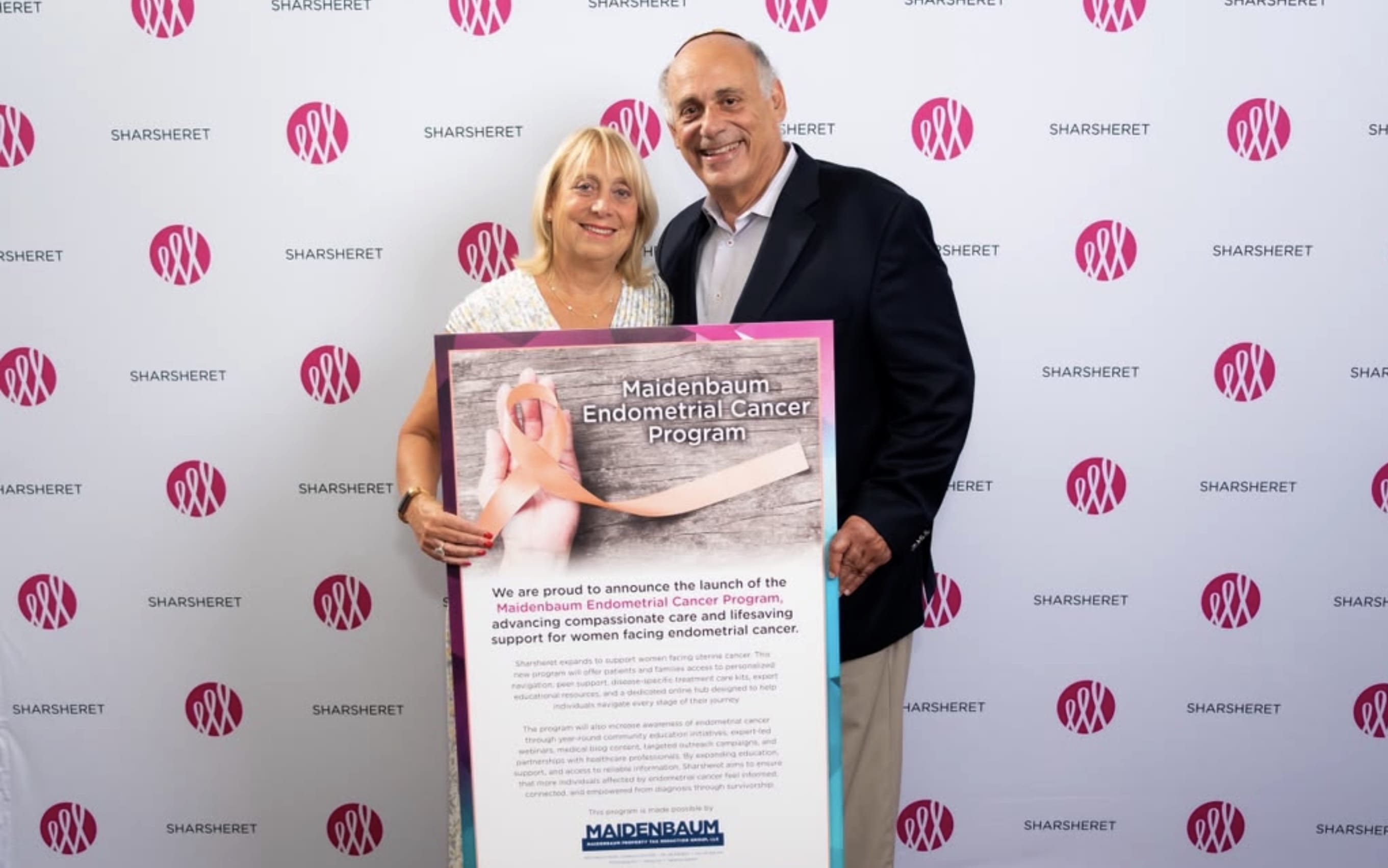
Things have since changed. On Aug. 26, 2026, Sharsharet announced it was broadening its mission to include endometrial cancer, thanks to a generous contribution from the Maidenbaum Property Tax Reduction Group of Cedarhurst, New York.
Ensuring no one needs to navigate EC alone
The Maidenbaum Endometrial Cancer Program extends Sharsheret’s services to all women facing endometrial cancer — the most common type of uterine cancer — and includes:
- Individualized patient navigation, one-on-one peer support, and guidance to help women and their families navigate diagnosis, treatment, survivorship and life after cancer.
- Disease-specific resources such as endometrial cancer treatment care kits, educational materials and a dedicated online resource hub offering reliable, up-to-date information tailored to every stage of the cancer journey.
- Year-round educational programming, including expert-led webinars, medical blog content, community outreach initiatives and partnerships with healthcare professionals to increase awareness and improve access to trusted information about endometrial cancer.
“A diagnosis of endometrial cancer can leave women and their families searching for answers, resources and connection,” said Adina Fleischmann, Sharsheret’s chief services officer, in a press release. “This program ensures no one has to navigate the experience alone by providing personalized support, trusted education, and meaningful connections every step of the way.”
Jewish women have a higher risk of developing several cancers. Research shows that one in 40 Ashkenazi Jews (those of Eastern European origin) and one in 140 Sephardic Jews (those from the Middle East or North Africa) carry a harmful mutation in the BRCA1 or BRCA2 genes. In comparison, in the general population between one in 300 and one in 800 carry these mutations. BRCA1 and BRCA2 mutations can significantly increase the risk of developing breast, ovarian, pancreatic, prostate and some other cancers.
Yet no established link exists between Ashkenazi Jewish origin and endometrial cancer, said Peggy Cottrell, a genetics counselor with Sharsheret.
“There really is only a very slightly increased risk for serious uterine cancer” for women with BRCA1 or BRCA2 mutations, Cottrell said. “Most cancers of the uterus are endometrial, but not all. It turns out that with endometrial cancer, there is an inherited kind, caused not by BRCA but by Lynch syndrome. And that’s associated with five genes which increases the risk for colon and endometrial cancer.”
Learn more: “What is the connection between endometrial cancer and Lynch syndrome?”
CEO Elana Silber explained why Sharsheret still decided to add endometrial cancer to its roster.
“We’re always reviewing our programs and looking for ways we can improve,” she said. “Breast and ovarian cancers are primarily female cancers, so it’s natural that women with endometrial cancer would also be thinking about us. Clearly, there was a void in the community when it came to endometrial cancer — and we wanted to make sure our staff was trained.”
Experts in the field
Sharsheret (“chain” in Hebrew) was established in 2001. Silber joined as a volunteer in 2003, came on staff the following year and was named CEO in 2015. Since its founding, the charity has assisted some 40,000 people at risk of breast as well as ovarian cancer. Among other things, it provides personalized support, financial assistance and genetic counseling for those at increased risk of breast, ovarian and endometrial cancer.
Notably, not all those utilizing its services are Jews — and not all are women.
“Sharsheret is a Jewish organization, but we help women and men of all backgrounds,” Silber said, noting that in rare cases, men can develop breast cancer as well. “We estimate that 10%-20% of the people who reach out to us do not identify as Jewish. They’re referred by their medical doctors because we’re seen as experts in the field.”
At present, Sharsheret has 50 employees and an annual budget of $10.5 million. Headquartered in New York City, it operates in every region of the United States, and in January 2024 opened an office in Israel.
Revenue comes from individuals and philanthropies like UJA-Federation of New York and the Jewish Community Foundation of Los Angeles, as well as corporate support from AstraZeneca, Merck, Pfizer, Novartis, Lilly and other large pharmaceuticals, and a government grant from the U.S. Centers for Disease Control and Prevention.
In addition, Sharsheret hosts 950 online and in-person events a year. Upcoming events include the Discover Sharsheret Lunch & Learn on Oct. 15 at Shaare Zedeck Synagogue in San Juan, Puerto Rico; a Patient Wellness & Connection Day on Oct. 15 at Weill Cornell Medicine in New York City; and the panel discussion Genetic Testing Can Save Lives: Stories, Science, and Answers on Oct. 18 at JCC Greater Boston.
Given the well-established link between obesity and both breast and endometrial cancer, one topic of growing interest in the Jewish community has been the surging popularity of GLP-1 receptor agonist medications. To that end, Sharsheret is sponsoring an Oct. 19 webinar titled “Demystifying the Relationship Between GLP-1s and Cancer.”
Grossman, who’s no longer receiving active treatment for her cancer, said she feels fortunate to have connected with Sharsheret when she did.
“I think it’s a fantastic organization, and raising awareness is so important,” she said, adding that “there’s currently no test for endometrial cancer, so women should just trust their own bodies and do their own research when presented with options.”