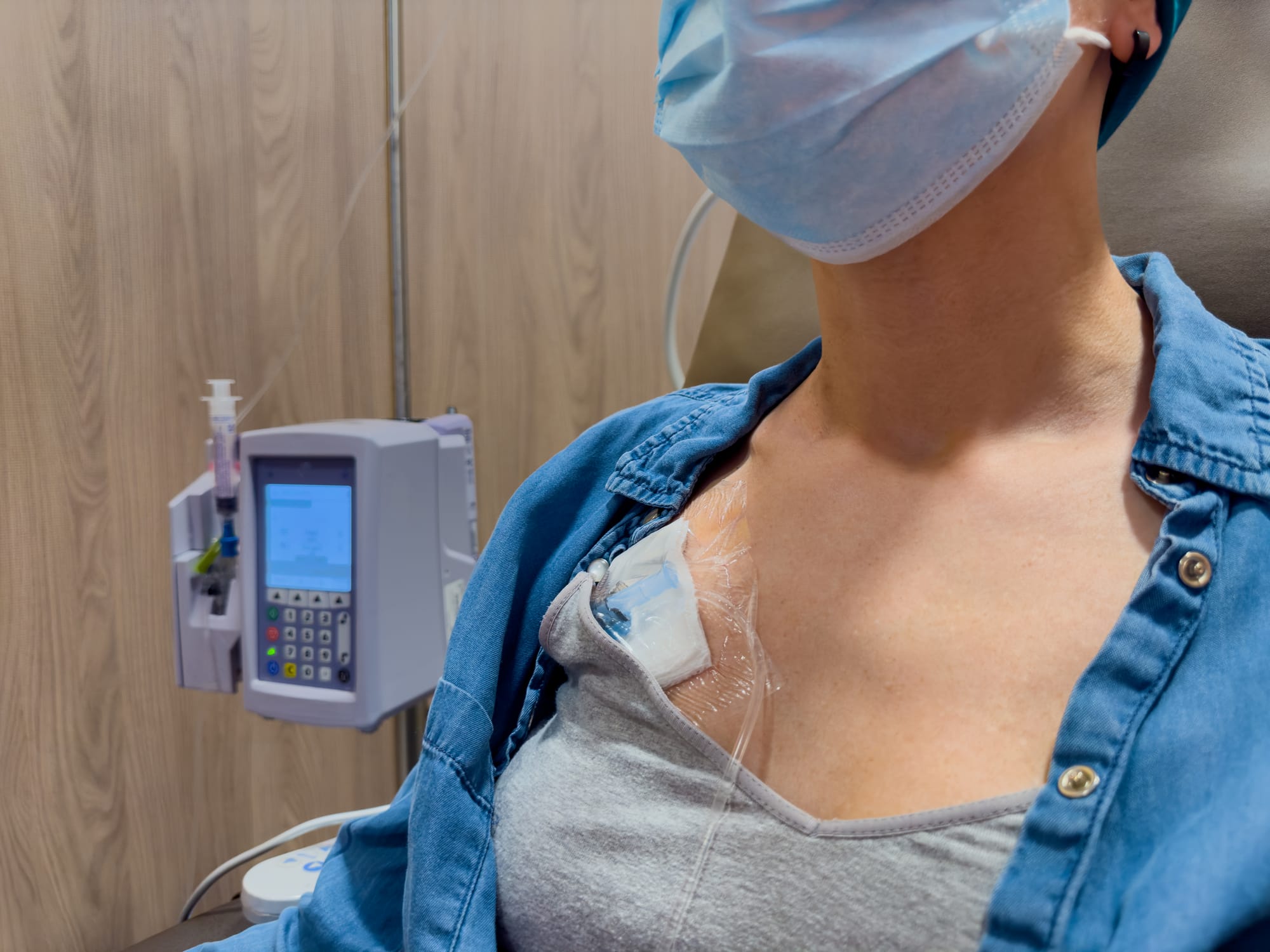
Chemotherapy for endometrial cancer (EC) may come with many IV lines placed over the course of several months—a worry for many, especially those with hard-to-find veins or a fear of needles. Over time, placing these lines can grow challenging: Chemotherapy drugs can be hard on the veins in your arm, causing damage.
A chemo port (also called a port-a-catheter or port-a-cath) provides a direct line to a larger vein in your chest, making infusions and blood draws easier. Whether or not to proceed with a chemo port is a decision made with your oncology team.
What is a chemo port?
A chemo port consists of a small disc made of plastic or metal (the port) and a thin plastic tube (the catheter) placed under the skin in the chest to deliver chemo drugs to a large vein in the upper chest. A chemo port stays in place for the duration of your treatment, regardless of whether it is weeks, months or years.
Each time you receive chemo, a needle will be inserted into the port to deliver the therapy, and then removed again at the end. The port will be periodically flushed out to avoid the development of blood clots.
The main advantage of a chemo port is that it simplifies accessing your veins for IV drips, blood draws, infusions or other treatments. This reduces the discomfort of regular needle sticks. It also prevents damage to the veins, since the larger vein in your chest is less likely to be damaged by chemotherapy drugs than the smaller veins in your arms.
How is a chemo port installed?
Installing a chemo port involves a surgical procedure to place it just under the collarbone, with the catheter going directly into the jugular vein or subclavian vein. The procedure leaves a small wound, which may create some discomfort initially but then quickly heals. There is a relatively low risk of inflammation or infection. In the case of infection, chemo is administered by IV until it heals.
Learn more about EC treatment and care
Should I opt for a chemo port during my endometrial cancer treatment?
The decision on whether or not to have a chemo port installed for your EC treatment will depend on several factors:
- The frequency and duration of your chemo: If you will only need a few chemo cycles, you may not need a chemo port. If your treatment will span several months, you might find it more convenient and more comfortable to have a chemo port.
- Your veins: Are your veins easy to access? Are they susceptible to bruising or rolling? If you know needle sticks are difficult for you, a chemo port may be worthwhile.
- Scaring: After they’re taken out and the site has healed, chemo ports leave an easily-hidden scar behind. For some patients, a small scar is well worth the benefits of a port, but others may see it as a permanent reminder they’d prefer to avoid.
- Constant presence: You live with a port even between chemo rounds. While for many a chemo port is barely noticeable, others may be bothered by the presence of something just under the skin. In particular, side and stomach sleepers may notice the port at night, and need to adjust their sleeping position.
- Alternative options: A port is just one kind of central line catheter. Another sometimes used for chemotherapy is a PICC line, which is placed in the upper arm. PICC lines need to be kept dry, so you can’t swim with one and will need to carefully protect it each time you shower. A PICC line can also be dislodged with heavy arm movement. For some patients a PICC line may be preferable to a port, while for others the PICC may mean too much hassle.
Sign up here to get the latest news, perspectives, and information about EC sent directly to your inbox. Registration is free and only takes a minute.